Inception - McCoy Tyner
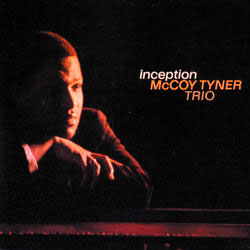
From the first solo chorus McCoy rips into on the title track Inception, it's clear that this record will be a tour de force by a pianist at the height of his powers. Building up to the fours Tyner exchanges with Elvin (lead into by a subtly polytonal ascending chordal line), McCoy unwinds an increasingly intricate series of lines, showcasing his technical prowess and harmonic insight.
There is No Greater Love features some great interplay with bassist Art Davis in the melody, as Art alternates between a cleverly staggered/delayed statement of the line that resolves to a unison with McCoy. McCoy's solo on this piece is less modal than that of Inception - he exploits the changes more, while still retaining the flavor of his work with Trane concurrent to this record. Elvin delivers masterful brushwork throughout - allowing Tyner to shine, Jones keeps his characteristic, highly propulsive accompaniment at just the right level not be intrusive, but quite sufficient to make it's presence known (the it seems safe to suspect that Jones was deliberately recorded "down" in the mix, judging from live recordings and firsthand accounts of Trane's group at this time).
Perhaps most reminiscent of Coltrane Quartet playing of this period, Blues For Gwen cooks along nicely throughout - not a standout, but another textbook example of Tyner's style at the time.
Art's use of arco on Sunset goes well with Tyner's more rhapsodic voicings and runs to create a an interlude of real grandeur, really changing the pace for this number. Lapses in and out of an explicitly pulse and more legato sections make for an enthralling interpretation of the melody - literally evocative of a stunning sunset. Elvin remains all but inaudible - even through the piano solo - easing in for part of the theme at the end before Tyner and Davis shift back to their looser tempo as a duet to close. In all, a refreshing take on a classic tune - an interpretation that really seems to get at the essence of the tune, something missed by many lesser artists, who merely read a song, even if it is to deliver dazzling (albeit not necessarily so relevant) solos. Just goes to show the power of orchestration and arrangement, devices made even more potent in a trio setting (like this one) that know how make the most of it.
For Effendi McCoy digs in for a smokin' mid-tempo romp on a tune that's an ideal launching point for some signature modal explorations. The melody is tailor-made for Tyner, neatly symmetrical patterns/motifs in the left hand (in unison with Davis) alternating with melodic chordal statements. Built on an interesting twist of the Impressions/So What progression (ABA), the group make the piece sound natural and right (i.e. not as if there's 8 bars missing). Again evidencing their mastery: Getting inside the tune, and playing to it's fullest.
Beginning with a an ostinato bass riff and Elvin's signature polyrhythmic latin pulse, Speak Low is a (not exactly understated) showcase of the trio in full form, Tyner streaming out meticulously constructed lines of brilliant harmonic detail - at once modal-sounding and simultaneously riding and substituting the changes. This tune is taken at a perfect tempo, up enough that it cooks along, rolling forward as if by it's own momentum. Elvin nuances the pulse, creating an ahead of the beat impression, adding to this sense of propulsion.
As the name implies, Inception was Tyner's debut recording effort as a leader. Without question, the record is a testament to the notion that there's nothing wrong with waiting til you're ready. Inception is largely a showcase for Tyner, and as such provides a wonderful documentation of his playing during this period, in particular his playing outside of the Coltrane Quartet. With inception, we're treated to some insights as to McCoy's individual aesthetic, with his modal vocabulary being applied to more standard tunes/progressions. Definitely essential listening for Tyner fans and Trane Quartet devotees.
Inception (Impulse A 18)
Rudy Van Gelder Studio, Englewood Cliffs, NJ
January 10 & 11, 1962



 Posts
Posts

