Showing posts sorted by relevance for query kind% of blue. Sort by date Show all posts

Kind of Blue - Miles Davis
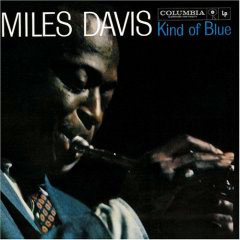
Kind of Blue - Miles Davis
How many times have we been subjected to remake after unmemorable remake of the tunes on Kind of Blue? Most readings of these songs are largely forgettable, especially when held up alongside the originals - seems Miles and his subsequent groups were the only ones that consistently did these pieces justice. This said, it goes without saying that this album was, still is and will always be an indispensable cornerstone of any jazz collection - one of those records I'd venture to say "If you could only have one jazz CD, make sure it's..."

What really makes it hold up as a timeless classic is the all-around stellar playing of the group, no doubt in part inspired by Miles' selection of material: His "introduction" of modal harmonic structures in these pieces, and the fresh ideas the material elicited in the quintet's playing. The most oft-cited piece in this regard is the (in)famous So What, for obvious reasons. We all know this became a Trane standard as Impressions - and a blazing uptempo romp for the 60s Miles quintets - and was recycled as a number of other tunes by other groups. So What is one of the quintessential tunes in every aspiring jazz player's book (required reading for Jazz 101, that only gets more enigmatic and challenging for PhD's - hence the myriad half-assed versions of this song that have been recorded and played of the years).

Interestingly, it's always struck me that the other really "modal" piece on the record is largely overlooked and underplayed (though that may be a blessing in disguise). To me, Flamenco Sketches allows the group to stretch out even more and really immerse themselves in modal improvisations. The solos are a bit more raw and vulnerable - without as steady a pulse, momentum is generated more by the line of the soloist's melody that the rhythm section - there's a uncommonly delicate, fragile beauty to both Miles and Coltrane's solos. While so much 60s Trane has been traced back to So What, in Flamenco Sketches I hear early strains of that more elusive, haunting quality that reappears later in Expression and pieces like Wise One, Crescent, Meditations, etc.

Cannonball's playing on Flamenco is equally intriguing - imbued with a ecstatic yet poignant drive, it almost captures the joyous energy of his later Live at The Club classics, but in the more subdued context of this recording. Evans seems in his element here - if anyone's later work can be traced back to anything on Kind of Blue, the moods and colors Evans creates on Sketches seem most evocative of the shape of things to come...

Of course, I'm as guilty as the next guy with regards to having committed countless crimes in the name of So What - dunno how many times I've played it, but do know of only a few where I've even come close to really playing it. A recent listen to Kind of Blue rekindled my interest in Flamenco Sketches, and have been delightedly working on the tune ever since. Best part is: Flamenco feels fresh. Every time I play through it, the tune's full of new possibilities and surprises. Maybe that's more of how the group was hearing things back in '59. Whatever the case, the sextet's version still sounds fresh as ever - and I have renewed faith that these songs are far from played out. Avante-garde is more a state of mind, not a sound at a particular place in time...

Kind of Blue (Columbia CL 1355)
March 2 & April 6, 1959
Columbia 30th Street Studios, NYC


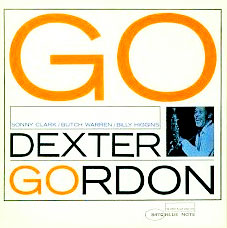
Go - Dexter Gordon

Go - Dexter Gordon
Right from and ' entrance over descending bass line on Cheese Cake, this album lives up to its name, and goes. Dexter wades right into his solo with a self-assured and confidence that leaves no question that this is going to be smokin set. His tone is expansive and majestic throughout - follows with a brief, terse and somewhat restrained post-boppish, post- solo before comes sailing back in for a few choruses, keeping the energy of the piece intact. It's easy to hear from the broad, rich tone plays with why is considered one of influences - check out the higher register wails works in.

The ballad that follows - I Guess I'll Hang My Tears Out To Dry - again seems reminiscent of . Like Soul Eyes, (perhaps somewhat inexplicably for myself - and myself alone) it vividly conjures up the image/sensation of a late night cab ride in NYC - say, speeding uptown on Lexington in the pouring rain on one of those first fall nights, when that first chill cuts through the damp air, yet the insular environs of that cab's back seat hold the cold at bay, and the city streams by serenely in a watery blur of bending light and shadow... Such obtuse imagery and metaphor aside, rich tone overflows from this tune, drawing the listener in, immersing you in a curious ennui...

The more rollicking Second Balcony Jump changes the pace to more of a straight-up, joyous blowing session. nimbly timekeeping keeps a slightly loose pulse - creating an infectious swing on this tune. draws us into the groove further with the latin intro on Love For Sale. Dexter's statement of the melody - and his soaring, caterwauling, singing solo that follow conspire to make this perhaps my favorite recording of this piece. sounds at once majestic and sarcastic: injecting wry turns of phrase into lines that evoke a sense of grandeur that transcends the tune itself. His mariachi-esque entrance after solo soon gives way to brilliant ascending arpeggios nearly spanning the range of the horn, replete with fat, bulbous low register honks (again bringing to mind playing of this period) to keening, almost vocal upper-register wails.

Where Are You brings me back to those autumnal, rain-slicked city streets, with Dexter again conjuring a sense of a kind of regal loneliness - that incomparable realization of aloneness that the city can evoke at times...

Announcing its arrival with a quote from ' classic If I Were A Bell, Three In The Morning is another mid tempo number that shines on: Asserting his cool, confident mastery of the instrument and the idiom. As described Dexter's style of dress - "cleaner than a broke-dick dog" - this tune (an otherwise typical, forgettable hard-bop vehicle) is transformed at Gordon's hands into something with much more class - again, transcendent. One only need listen to Clarke's perfectly adroit and idiomatic solo in contrast to Gordon's playing, and Dexter's greatness is evident. Once more, Gordon enters after Sonny's solo with a tongue-in-cheek quote from Take Me Out To The Ballgame - almost trivializing Clarke's solo. Not to undermine Sonny - he's one of my favorite pianists of this period and style - just that the clarity of Dexter's inspiration on this date is in such a league of its own, rather overshadowing the playing of the rest of the band. From the perspective of being "Dexter's band," however, their performance is stellar all around. Completely supportive as a rhythm section, they lay down an infallible groove throughout, and deliver a few more modest solos that set off Gordon's work as all the more dazzling - solos that in other contexts that in their own right are nothing to be scoffed at.

What's important here, is that Go! is clearly a Dexter Gordon album - a wonderful documentation of a man playing at the height of his powers. Go! is definitely one that should be on the short list for any fan of hard-bop, 60s jazz - or for that matter, anybody with ears.

Go! (Blue Note - BLP 4112)
Rudy Van Gelder Studio, Englewood Cliffs, NJ
August 27, 1962