Showing posts sorted by relevance for query monk. Sort by date Show all posts

Thelonious Monk Quartet with John Coltrane at Carnegie Hall

Monk & Trane at Carnegie Hall
Being a devotee of classic jazz, it's not often that I find myself on the edge of my seat with anticipation of a new release. Such momentous events as the the coming to light of a rarity like this & Trane set doesn't happen every day - come to think of it, I still remember getting fired up when the Five Spot recordings surfaced. Though the music on from the Five Spot recordings was electrifying, the fidelity of the recordings themselves left a bit to be desired. No so with The Thelonious Monk Quartet at Carnegie Hall CD - this is the next best thing to studio quality (bass is a little weak, and drums a bit loud and boomy at times - these being rather realistic characteristics of the Hall though).

"Early Show"
Whatever the case, the music recorded that night in '57 is as magical today as it was then. Monk's Mood here is played here with an incredible poignancy: Thelonious' solo intro chorus shows the pianist at the height of his powers, manipulating time and harmony brilliantly. Trane comes in with his statement of the melody after a breathtaking duet of cascading, fluid, intertwining lines exchanged with Monk - then the two proceed through staggeringly beautiful interpretation of the melody. Time is elastic, yet the pulse remains firmly implied as Monk & Trane (and ) continue to reiterate the melody, embellishing it with ever-more dazzling interplays of runs with each successive chorus. Always one of my favorite Monk tunes, this version stands out amongst recordings I've heard - Monk & Trane are truly playing as one here, completely inside the tune, inside the moment, inside each other's ideas. This piece alone is worth the price of admission: One of the most beautiful pieces of music one could ever hope to hear.

This of course, is just the beginning. After the transcendent, cathartic, timeless moments of Monk's Mood, the quartet launches into Evidence. After a few choruses, Trane is up to speed, "sheets of sound" unfurling effortlessly, pushing the progression ahead with a gloriously relentless inevitability. A deceptively simple (or seemingly standard) A section of the progression is transformed by Coltrane into stunning, brilliant architecture of arpeggios and dizzying runs. Monk delivers a what can only be described as a perfectly Monkish solo: an idiom unto himself, he fully exploits his singular vocabulary here. Trane's subtle (almost tentative?) return with the melody finds Monk setting up a great, funky offbeat accompaniment - comping in between the accents of the melody, maximizing the angularity and propulsive nature of the line.

We're treated to some more unaccompanied Monk for the first chorus of Crepuscle With Nellie (wouldn't want it any other way). Coltrane enters with the rhythm section, languidly stating the melody in unison with Monk, Thelonious interjecting the occasional, ideally timed cluster comps that leap up from the mix, jagged accents in the otherwise still soundscape of the piece.

Nutty abruptly changes the mood - making his presence known with some well-placed accents (a la famous "bombs") - and Trane barging in for a few searing choruses leading up to Monk's spartan solo, lines of fragile, delicate beauty that never stray far from the melody. The theme reemerges effortlessly and the quartet wraps up this succinct (and comparatively "sane") version of Nutty before the closing number of the "Early Show."

& set up a sizzling polyrhythmic groove against the melody of Epistrophy, as Monk & Trane state the melody together. This tune seems tailor-made for Trane - the progression ideally suited for his harmonic explorations and spiraling patterns. Thelonious again juxtaposes the roiling density of Trane's closing solo statements with a sparse entrance. Monk takes a brief solo punctuated with a few deftly placed careening runs, before the group cooks their way through the closing melody.

"Late Show"
...coming soon...


The Thelonious Monk Quartet at Carnegie Hall (Blue Note 0946)
Carnegie Hall, NYC
November 29, 1957

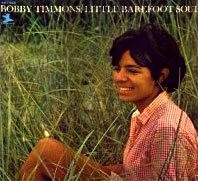
Little Barefoot Soul - Bobby Timmons

Little Barefoot Soul - Bobby Timmons
Probably most widely known for being the composer of the Art Blakey (Jazz Messengers) classic Moanin', Bobby Timmons lays down some equally (if not more) funky tracks on these Prestige sides, originally released as Little Barefoot Soul and Chun-King. The opening title track gets off to solid, soulful groove simply stated by Sam Jones and and Ray Lucas - Timmons< strolls for a chorus and then enters with the the melody and doubles the bass riff with his left hand. The solo to follow is classic hard-bop of the period: The first few choruses a bit Monkish with some nicely percussive clusters and fragmentations of the line as the vamp continues underneath. The tension created has the energy built up nicely by the time Jones settles into a walking line. Timmons continues a his bluesy solo, punctuating with some interesting descending diminished lines (that set the stage for more explorations in this tonality) and other brief forays away from the standard blues changes that one would anticipate - all working together to keep the tune fresh and engaging.

Little One opens with an infectious riff on top of which Timmons lays down a brilliantly voiced theme. His use of dense, clustered chords to state this theme sets up wonderful tension that's released as the group launches into the bridge. The openeing vamp is returned to and is held through Timmons' solo (reminiscent of Bud Powell's classic Una Poco Loco, though noticeably less searing/pyrotechinically dazzling) which again makes use of clever and sparing departures from the basic tonality.

Timmons sticks close to the melody on his solo interpretation of Nobody Knows the Trouble I've Seen. Apart from not being a blues, this change in orchestrations helps to change up the mood - while still a bluesy reading of the tune, this piece stands out nicely just by dint of not being a blues form. Bobby makes some tasteful nods to Monk on this track - but the tune is a good example of Timmons somewhat unique way of approaching a ballad as a solo. On the Prestige Trio sessions reissue, this tune is placed 5th - it appeared third on the original Little Barefoot Soul (Prestige PR 7335), a placement which did a lot more to break up the blues progression-based pieces on the record.

Cut Me Loose Charlie - yet another blues form - also opens with a propulsive bass and drum vamp, a motif that's used throughout the tune, both as a device to create some tension under Bobby's solo, and a way to differentiate the tune's feel from that of the other blues progression-based songs on the album.

Ain't Thinkin' 'Bout It is another blues, rendered in a more standard fashion (no vamp, that is) - and though highlighted by some interesting, clustered chord voicings in the opening theme statement, this tune soon becomes the most forgettable number on the record: A typical arrangement and interpretation of the blues form in the soul-jazz/hard-bop vocabulary that Timmons was speaking in at the time. This said, the tune is nonetheless a great study of Timmons' playing form this period - full of textbook examples (along with some not-so-textbook, more atonal ventures) of the post-Powell, funkier school of piano playing that Timmons was defining in the early 60s.

Another blues, Walkin'-Wadin'-Sittin'-Ridin' closes the set with an easy groove - Bobby's solo is marked by some nice uses of space, interspersed with some faster Powell-flavored runs that seem to want to push the rhythm section into double-time. Jones & Lucas hold it steady, with Timmons reeling it back in to bluesy statements and more occasionally Monkish lines & clusters. (This tune is presented 2nd on the Prestige reissue - again, it's placement as the final cut on Little Barefoot Soul seems to better suit the arc of the album as a whole).

Apart from being a groovin and enjoyable record to listen to as well a crash course in how to play funky, soulful hard-bop piano, Little Barefoot Soul is also a fine example of how to keep what's essentially an album full of blues from sounding stale. Timmons steers clear of dazzling technical displays or complex arrangements to get his point across while keeping it fresh. Instead, his generally sparing solos make deft use of thematic development, well-placed blues cliches and sporadic dashes of unexpected harmonies and tonalities - all mixing up into a recipe for an album full of blues that comes off as much more than I-IV-V progressions and tired blues licks.

Little Barefoot Soul (Prestige PR 7335)
Rudy Van Gelder Studio, Englewood Cliffs, NJ
June 18, 1964