Showing posts sorted by relevance for query so%what. Sort by date Show all posts

Kind of Blue - Miles Davis
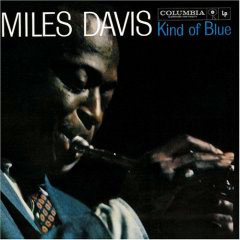
Kind of Blue - Miles Davis
How many times have we been subjected to remake after unmemorable remake of the tunes on Kind of Blue? Most readings of these songs are largely forgettable, especially when held up alongside the originals - seems Miles and his subsequent groups were the only ones that consistently did these pieces justice. This said, it goes without saying that this album was, still is and will always be an indispensable cornerstone of any jazz collection - one of those records I'd venture to say "If you could only have one jazz CD, make sure it's..."

What really makes it hold up as a timeless classic is the all-around stellar playing of the group, no doubt in part inspired by Miles' selection of material: His "introduction" of modal harmonic structures in these pieces, and the fresh ideas the material elicited in the quintet's playing. The most oft-cited piece in this regard is the (in)famous So What, for obvious reasons. We all know this became a Trane standard as Impressions - and a blazing uptempo romp for the 60s Miles quintets - and was recycled as a number of other tunes by other groups. So What is one of the quintessential tunes in every aspiring jazz player's book (required reading for Jazz 101, that only gets more enigmatic and challenging for PhD's - hence the myriad half-assed versions of this song that have been recorded and played of the years).

Interestingly, it's always struck me that the other really "modal" piece on the record is largely overlooked and underplayed (though that may be a blessing in disguise). To me, Flamenco Sketches allows the group to stretch out even more and really immerse themselves in modal improvisations. The solos are a bit more raw and vulnerable - without as steady a pulse, momentum is generated more by the line of the soloist's melody that the rhythm section - there's a uncommonly delicate, fragile beauty to both Miles and Coltrane's solos. While so much 60s Trane has been traced back to So What, in Flamenco Sketches I hear early strains of that more elusive, haunting quality that reappears later in Expression and pieces like Wise One, Crescent, Meditations, etc.

Cannonball's playing on Flamenco is equally intriguing - imbued with a ecstatic yet poignant drive, it almost captures the joyous energy of his later Live at The Club classics, but in the more subdued context of this recording. Evans seems in his element here - if anyone's later work can be traced back to anything on Kind of Blue, the moods and colors Evans creates on Sketches seem most evocative of the shape of things to come...

Of course, I'm as guilty as the next guy with regards to having committed countless crimes in the name of So What - dunno how many times I've played it, but do know of only a few where I've even come close to really playing it. A recent listen to Kind of Blue rekindled my interest in Flamenco Sketches, and have been delightedly working on the tune ever since. Best part is: Flamenco feels fresh. Every time I play through it, the tune's full of new possibilities and surprises. Maybe that's more of how the group was hearing things back in '59. Whatever the case, the sextet's version still sounds fresh as ever - and I have renewed faith that these songs are far from played out. Avante-garde is more a state of mind, not a sound at a particular place in time...

Kind of Blue (Columbia CL 1355)
March 2 & April 6, 1959
Columbia 30th Street Studios, NYC


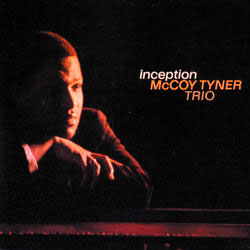
Inception - McCoy Tyner

Inception - McCoy Tyner
From the first solo chorus McCoy rips into on the title track Inception, it's clear that this record will be a tour de force by a pianist at the height of his powers. Building up to the fours exchanges with Elvin (lead into by a subtly polytonal ascending chordal line), McCoy unwinds an increasingly intricate series of lines, showcasing his technical prowess and harmonic insight.

There is No Greater Love features some great interplay with bassist in the melody, as Art alternates between a cleverly staggered/delayed statement of the line that resolves to a unison with McCoy. McCoy's solo on this piece is less modal than that of Inception - he exploits the changes more, while still retaining the flavor of his work with concurrent to this record. delivers masterful brushwork throughout - allowing Tyner to shine, Jones keeps his characteristic, highly propulsive accompaniment at just the right level not be intrusive, but quite sufficient to make it's presence known (the it seems safe to suspect that Jones was deliberately recorded "down" in the mix, judging from live recordings and firsthand accounts of Trane's group at this time).

Perhaps most reminiscent of Coltrane Quartet playing of this period, Blues For Gwen cooks along nicely throughout - not a standout, but another textbook example of Tyner's style at the time.

Art's use of arco on Sunset goes well with Tyner's more rhapsodic voicings and runs to create a an interlude of real grandeur, really changing the pace for this number. Lapses in and out of an explicitly pulse and more legato sections make for an enthralling interpretation of the melody - literally evocative of a stunning sunset. Elvin remains all but inaudible - even through the piano solo - easing in for part of the theme at the end before Tyner and Davis shift back to their looser tempo as a duet to close. In all, a refreshing take on a classic tune - an interpretation that really seems to get at the essence of the tune, something missed by many lesser artists, who merely read a song, even if it is to deliver dazzling (albeit not necessarily so relevant) solos. Just goes to show the power of orchestration and arrangement, devices made even more potent in a trio setting (like this one) that know how make the most of it.

For Effendi McCoy digs in for a smokin' mid-tempo romp on a tune that's an ideal launching point for some signature modal explorations. The melody is tailor-made for Tyner, neatly symmetrical patterns/motifs in the left hand (in unison with Davis) alternating with melodic chordal statements. Built on an interesting twist of the Impressions/So What progression (ABA), the group make the piece sound natural and right (i.e. not as if there's 8 bars missing). Again evidencing their mastery: Getting inside the tune, and playing to it's fullest.

Beginning with a an ostinato bass riff and Elvin's signature polyrhythmic latin pulse, Speak Low is a (not exactly understated) showcase of the trio in full form, Tyner streaming out meticulously constructed lines of brilliant harmonic detail - at once modal-sounding and simultaneously riding and substituting the changes. This tune is taken at a perfect tempo, up enough that it cooks along, rolling forward as if by it's own momentum. Elvin nuances the pulse, creating an ahead of the beat impression, adding to this sense of propulsion.

As the name implies, Inception was Tyner's debut recording effort as a leader. Without question, the record is a testament to the notion that there's nothing wrong with waiting til you're ready. Inception is largely a showcase for Tyner, and as such provides a wonderful documentation of his playing during this period, in particular his playing outside of the Coltrane Quartet. With inception, we're treated to some insights as to McCoy's individual aesthetic, with his modal vocabulary being applied to more standard tunes/progressions. Definitely essential listening for Tyner fans and Trane Quartet devotees.

Inception (Impulse A 18)
Rudy Van Gelder Studio, Englewood Cliffs, NJ
January 10 & 11, 1962

Boss Guitar - Wes Montgomery

Boss Guitar - Wes Montgomery
Not everybody can pull off a opening vamp like the one for Besame Mucho - but Mel Rhyne & Jimmy Cobb make it happen. For that matter, not many can pull off a tune like Besame Mucho, but Wes, Mel & Jimmy are just the guys for the job.
Boss Guitar is one of Wes Montgomery's classic Riverside albums - a must-have for any guitarist, jazz player or not. Apart being a tour de force on the guitar, this record also highlights Wes' great ability to take tunes like Besame Mucho - that can be painfully square if one isn't careful - and make them respectably hip. After all, it's not the song, but how you play it - an art Wes had clearly mastered (some of his later work, like Tequila notwithstanding, but that's another story...)

Besame Mucho isn't the only such potentially hazardous "ole chestnut" on this record. Canadian Sunset and Dearly Beloved can be easily mishandled, and oftentimes have at the hands of less gifted musicians. Wes, however, simply simmers his way through these more uptempo numbers (the choice of these tempos doesn't hurt the hipness quotient) with his characteristic aplomb. One of the great hallmarks of Montgomery's virtuosity is the effortlessness with which he plays, particularly at medium to up tempos. Not just his much-lauded switching from single note lines to octaves and on to chord solos, but the ease and melodicism which which the solos flow, all technical prowess aside.

Listen closely to Wes' lines and melodies: like Miles and Bird solos, these lines has a certain inevitable quality, playing out the way they do as if by destiny, as if there was no better way to do so. Wes has a uncanny knack for getting lines to "land on their feet" no what what unexpected twists and turns they may take on the way. Also evident on these tunes - Dearly Beloved and Canadian Sunset especially - is Wes ' remarkable ability to interject and punctuate open, soaring melodies with blues phrases that are organic parts of the line, and not hackneyed cliches. (No wonder Montgomery was Trane's pick as a guitarist for his early 60s group).

The tune that really takes the "chestnut" prize on this record is Dearly Beloved. Talk about a number that's no picnic to pull off - take any tune at a tempo this slow, and most groups are asking for trouble. Add to that the fact that half of your rhythm section is an organist, and most listeners will be dozing off before you're done counting in the opening bar... Again, the group (Wes in particular) rises to occasion and makes it work. Mel's solo has a few faltering moments on the harmonic thin ice, but overall, Mel's the man on this tune, his accompaniment sustaining the momentum of the piece and doing a lot to define the mood. Jimmy Cobb's tastefully obsequious playing doesn't hurt either.

Boss Guitar (Riverside RLP 459)
Plaza Sound Studios, NYC
April 22, 1963


Ain't It Funky Now

One of the oft-overlooked facets of funk is the need to "keep it in the pocket." James Brown (the JB's for that matter) really had this down - just holding a groove solid behind a soloist. Not getting louder or more dense as the solo builds. Not following every little ebb and flow. A lot of classic hard bop (even early bebop) rolls this way too - the rhythm section just hunkers down, cookin' along, leaving the bulk of the embellishments and dynamic/density variations to the soloist and the drummers' fills. And I'll tell you: As a soloist, this can be a really liberating situation, and also, one that's not as common as one might expect. Many sidemen feel the need to (over)react to everything the soloist does - so much so, that they're practically soling themselves. Chalk it up to misinterpretation of the Coltrane quartet, Ornette, free jazz, and collateral damage from the Berklee grad pyrotechnics and the "jam band" mentalities - everyone blowing all their chops all at once, all the time.


On 1970's "Green is Beautiful" Grant and company provide a study in how not to succumb to this unfunky fate of being "out of the pocket." The organist Emmanuel Riggins hangs tenaciously on the vamp, along with Jimmy Lewis keepin' it on the one with the electric bass. Percussionists Candido Camero and Richie "Pablo" Landrum sit tight in the groove as well - it's really only drummer Idris Muhammad that steps it out a bit withe soloists. Muhammad's playing really kicks it - striking me at times as an Elvin Jones type of approach to funk - visceral, raw and undeniably propulsive. Even under Blue Mitchell, Claude Bartee and Riggins' solos, Grant himself schools us on how to hold it down, sticking to a percussive octave and chordal pattern to punctuate the groove.

Green's soloing here is of course the standout here. His blues-inflected riffing, gradually developing a phrase or motif as a theme is really in fine form. He never needs to resort to any dazzling runs or complex harmonic machinations to maintain interest - instead Grant just patiently spins out phrase after phrase, developing his ideas with what seems like an inexorable logic and economy. Moreover, his timing, accents and placements keep it funky. While he doesn't use space nearly as much, his time evokes Miles in the sense of dropping the note (or phrase) right where it needs to land. Perhaps the essence of funk, right there.

Ain't It Funky Now
Grant Green - Green Is Beautiful (Blue Note BST 84342)
January 30, 1970

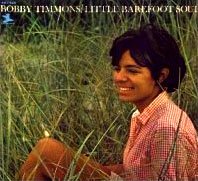
Little Barefoot Soul - Bobby Timmons

Little Barefoot Soul - Bobby Timmons
Probably most widely known for being the composer of the Art Blakey (Jazz Messengers) classic Moanin', Bobby Timmons lays down some equally (if not more) funky tracks on these Prestige sides, originally released as Little Barefoot Soul and Chun-King. The opening title track gets off to solid, soulful groove simply stated by Sam Jones and and Ray Lucas - Timmons< strolls for a chorus and then enters with the the melody and doubles the bass riff with his left hand. The solo to follow is classic hard-bop of the period: The first few choruses a bit Monkish with some nicely percussive clusters and fragmentations of the line as the vamp continues underneath. The tension created has the energy built up nicely by the time Jones settles into a walking line. Timmons continues a his bluesy solo, punctuating with some interesting descending diminished lines (that set the stage for more explorations in this tonality) and other brief forays away from the standard blues changes that one would anticipate - all working together to keep the tune fresh and engaging.

Little One opens with an infectious riff on top of which Timmons lays down a brilliantly voiced theme. His use of dense, clustered chords to state this theme sets up wonderful tension that's released as the group launches into the bridge. The openeing vamp is returned to and is held through Timmons' solo (reminiscent of Bud Powell's classic Una Poco Loco, though noticeably less searing/pyrotechinically dazzling) which again makes use of clever and sparing departures from the basic tonality.

Timmons sticks close to the melody on his solo interpretation of Nobody Knows the Trouble I've Seen. Apart from not being a blues, this change in orchestrations helps to change up the mood - while still a bluesy reading of the tune, this piece stands out nicely just by dint of not being a blues form. Bobby makes some tasteful nods to Monk on this track - but the tune is a good example of Timmons somewhat unique way of approaching a ballad as a solo. On the Prestige Trio sessions reissue, this tune is placed 5th - it appeared third on the original Little Barefoot Soul (Prestige PR 7335), a placement which did a lot more to break up the blues progression-based pieces on the record.

Cut Me Loose Charlie - yet another blues form - also opens with a propulsive bass and drum vamp, a motif that's used throughout the tune, both as a device to create some tension under Bobby's solo, and a way to differentiate the tune's feel from that of the other blues progression-based songs on the album.

Ain't Thinkin' 'Bout It is another blues, rendered in a more standard fashion (no vamp, that is) - and though highlighted by some interesting, clustered chord voicings in the opening theme statement, this tune soon becomes the most forgettable number on the record: A typical arrangement and interpretation of the blues form in the soul-jazz/hard-bop vocabulary that Timmons was speaking in at the time. This said, the tune is nonetheless a great study of Timmons' playing form this period - full of textbook examples (along with some not-so-textbook, more atonal ventures) of the post-Powell, funkier school of piano playing that Timmons was defining in the early 60s.

Another blues, Walkin'-Wadin'-Sittin'-Ridin' closes the set with an easy groove - Bobby's solo is marked by some nice uses of space, interspersed with some faster Powell-flavored runs that seem to want to push the rhythm section into double-time. Jones & Lucas hold it steady, with Timmons reeling it back in to bluesy statements and more occasionally Monkish lines & clusters. (This tune is presented 2nd on the Prestige reissue - again, it's placement as the final cut on Little Barefoot Soul seems to better suit the arc of the album as a whole).

Apart from being a groovin and enjoyable record to listen to as well a crash course in how to play funky, soulful hard-bop piano, Little Barefoot Soul is also a fine example of how to keep what's essentially an album full of blues from sounding stale. Timmons steers clear of dazzling technical displays or complex arrangements to get his point across while keeping it fresh. Instead, his generally sparing solos make deft use of thematic development, well-placed blues cliches and sporadic dashes of unexpected harmonies and tonalities - all mixing up into a recipe for an album full of blues that comes off as much more than I-IV-V progressions and tired blues licks.

Little Barefoot Soul (Prestige PR 7335)
Rudy Van Gelder Studio, Englewood Cliffs, NJ
June 18, 1964

Thelonious Monk Quartet with John Coltrane at Carnegie Hall

Monk & Trane at Carnegie Hall
Being a devotee of classic jazz, it's not often that I find myself on the edge of my seat with anticipation of a new release. Such momentous events as the the coming to light of a rarity like this & Trane set doesn't happen every day - come to think of it, I still remember getting fired up when the Five Spot recordings surfaced. Though the music on from the Five Spot recordings was electrifying, the fidelity of the recordings themselves left a bit to be desired. No so with The Thelonious Monk Quartet at Carnegie Hall CD - this is the next best thing to studio quality (bass is a little weak, and drums a bit loud and boomy at times - these being rather realistic characteristics of the Hall though).

"Early Show"
Whatever the case, the music recorded that night in '57 is as magical today as it was then. Monk's Mood here is played here with an incredible poignancy: Thelonious' solo intro chorus shows the pianist at the height of his powers, manipulating time and harmony brilliantly. Trane comes in with his statement of the melody after a breathtaking duet of cascading, fluid, intertwining lines exchanged with Monk - then the two proceed through staggeringly beautiful interpretation of the melody. Time is elastic, yet the pulse remains firmly implied as Monk & Trane (and ) continue to reiterate the melody, embellishing it with ever-more dazzling interplays of runs with each successive chorus. Always one of my favorite Monk tunes, this version stands out amongst recordings I've heard - Monk & Trane are truly playing as one here, completely inside the tune, inside the moment, inside each other's ideas. This piece alone is worth the price of admission: One of the most beautiful pieces of music one could ever hope to hear.

This of course, is just the beginning. After the transcendent, cathartic, timeless moments of Monk's Mood, the quartet launches into Evidence. After a few choruses, Trane is up to speed, "sheets of sound" unfurling effortlessly, pushing the progression ahead with a gloriously relentless inevitability. A deceptively simple (or seemingly standard) A section of the progression is transformed by Coltrane into stunning, brilliant architecture of arpeggios and dizzying runs. Monk delivers a what can only be described as a perfectly Monkish solo: an idiom unto himself, he fully exploits his singular vocabulary here. Trane's subtle (almost tentative?) return with the melody finds Monk setting up a great, funky offbeat accompaniment - comping in between the accents of the melody, maximizing the angularity and propulsive nature of the line.

We're treated to some more unaccompanied Monk for the first chorus of Crepuscle With Nellie (wouldn't want it any other way). Coltrane enters with the rhythm section, languidly stating the melody in unison with Monk, Thelonious interjecting the occasional, ideally timed cluster comps that leap up from the mix, jagged accents in the otherwise still soundscape of the piece.

Nutty abruptly changes the mood - making his presence known with some well-placed accents (a la famous "bombs") - and Trane barging in for a few searing choruses leading up to Monk's spartan solo, lines of fragile, delicate beauty that never stray far from the melody. The theme reemerges effortlessly and the quartet wraps up this succinct (and comparatively "sane") version of Nutty before the closing number of the "Early Show."

& set up a sizzling polyrhythmic groove against the melody of Epistrophy, as Monk & Trane state the melody together. This tune seems tailor-made for Trane - the progression ideally suited for his harmonic explorations and spiraling patterns. Thelonious again juxtaposes the roiling density of Trane's closing solo statements with a sparse entrance. Monk takes a brief solo punctuated with a few deftly placed careening runs, before the group cooks their way through the closing melody.

"Late Show"
...coming soon...


The Thelonious Monk Quartet at Carnegie Hall (Blue Note 0946)
Carnegie Hall, NYC
November 29, 1957